

6 Facts: What It’s Nice To Know About AI
July 28, 2026
Why Water Is a Worry
July 30, 2026
Uber will charge us $136 to drive from the Port Authority Bus Terminal in NYC to Kennedy International Airport. Slightly less, Lyft is $134.
With Throo, it could be $80.
Throo is showing us how to break up a duopoly.
Ride-Share Markets
After recently arriving in NYC, Throo tells us that 50,000 drivers have so far installed their app. The incentive? They will charge drivers a smaller fixed fee for each ride. Then, on the demand side, customers pay less.
Based in Singapore, TADA is offering us the Throo app. Its goal is to get a slice of the for-hire/taxi trips in New York City. Right now, Uber and Lyft control 80 percent of the market while traditional taxis are at 20 percent.
Our Bottom Line: Competition
Through Throo, TADA hopes to break up the duopoly dominated by two large firms.
Like Uber and Lyft, Throo will pay the same taxes and fees. However, by charging approximately $1 less per fare, TADA lets the driver keep more. Or, as a TADA founder said, “We take care of the driver first, and the driver can take care of the riders…” In Singapore, the approach worked.
TADA explained it would compete by growing quickly to the 10,000 rides a day that the app can accommodate. (Lyft averaged 218,417 trips per day in May 2026 while Uber’s were 495,317.) According to TADA’s co-founder, they penetrate a market when drivers “start comparing the price between Uber and TADA instead of Uber and Lyft…What we need to do is to try to build a habit for them to compare the price.”
In the past, we’ve noted that firms occupying the far right region of our competitive markets continuum avoid price competition. Instead, companies like Coca-Cola and Kellogg’s use product differentiation. However, some ride-share companies compete differently. TADA uses its pricing power to lower what it charges.
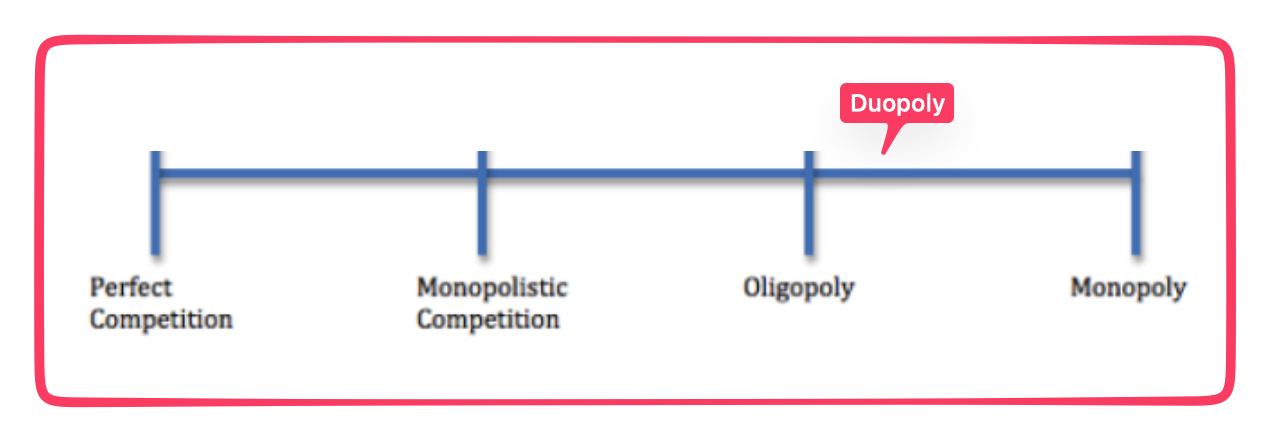
Unlike its oligopolistic sisters, just two firms compete in a duopoly. But if Throo is successful, then we might have to switch our market structure to oligopoly:
My sources and more: Today’s facts came from the two NY Times articles, here and here, that grabbed me. Then, The Korea Herald had more detail, as did rideobi. And for more on duopoly, econlife looked at ice cream cones and beer markets.